


AI has created its own job in construction.

Guess what is the tech industry’s solution to construction labor shortages delaying AI data centers
Did you say “AI”? Go to the top of the class.
Apparently there aren’t enough qualified tradespeople to satisfy a sudden demand for construction workers. The chief complainants about this lack of construction capacity are [drum roll] tech companies, who apparently can’t get their data centers built quickly enough because of a pesky lack of people to build them.
Stuffy old 20th century economists might opine that this overwhelming demand might lead to higher wages for construction workers and an influx of labor into the industry, but Silicon Valley has a much better idea than that. What we need, friends, is… an app.
There’s a lot to unpack here, and it all starts from the assumption that there’s a pool of labor just waiting to get to work building data centers, if only someone—or something!—would tell them how to do so. More here: (Source)
The S/M Take:
Well, that didn’t take long.
AI needs more data centers. Data centers need more construction workers. So naturally, someone built an AI tool for construction workers.
Jokes aside, there are real people underneath all these labor-shortage stats trying to get more done with the crew they have. And that makes anything that helps them do more with the same two hands increasingly valuable.
Tech. Training. Simpler installs. Better jobsite support. Keep that thought in your toolbelt as we head to Story Two.

ABC survey: 1 in 6 members perform data center work; backlog rebounds in August
Associated Builders and Contractors reported that its Construction Backlog Indicator rebounded to 8.5 months in August, according to an ABC member survey conducted Aug. 20 to Sept. 4. The reading is up 0.5 months from July and unchanged on a year-ago basis.
“Data centers continue to keep contractors busy even as activity softens in other segments. Although the backlog gap between contractors with and without data center work narrowed in August (9.9 vs. 8.3 months, respectively), that appears to reflect more contractors securing work in the data center segment rather than a broader structural trend.
“Roughly 1 in 6 ABC members is currently under contract to work on a data center, the highest proportion on record.” More here: (Source)
The S/M Take:
Whoa. One in six contractors working on data centers is a staggering number.
So, yeah. About that labor problem we were just talking about.
AI may live in the cloud, but building it still takes a hell of a lot of people on the ground. And those electricians, HVAC techs and skilled tradespeople were already pretty busy before ChatGPT needed an apartment.
We say to follow the leaders. Hilti has built a business around squeezing more productivity out of every labor hour through prefab, kitting, training and tools. Simpson Strong-Tie invests heavily in training and jobsite support. Procore lends a hand in figuring out where people should be in the first place.
If your product can save a contractor an hour, a phone call or a headache, speak up.
Construction in the Age of AI: Mapping the next generation of building
Drawing on academic research, case studies, expert interviews, survey input and an industry roundtable involving more than 50 industry leaders, the study identifies six priority areas for AI: design automation, offsite manufacturing, permitting, scheduling, skilled labor and subcontracting, and supply chain and procurement.
Modeling suggests that applying these levers together could drive up to 20 percent in total cost savings and 25 percent in schedule savings on a sample project, illustrating the scale of impact that AI-enabled delivery could have on feasibility and performance industry wide. More here: (Source)
The S/M Take:
Annnnnnnnd we’ve come full circle.
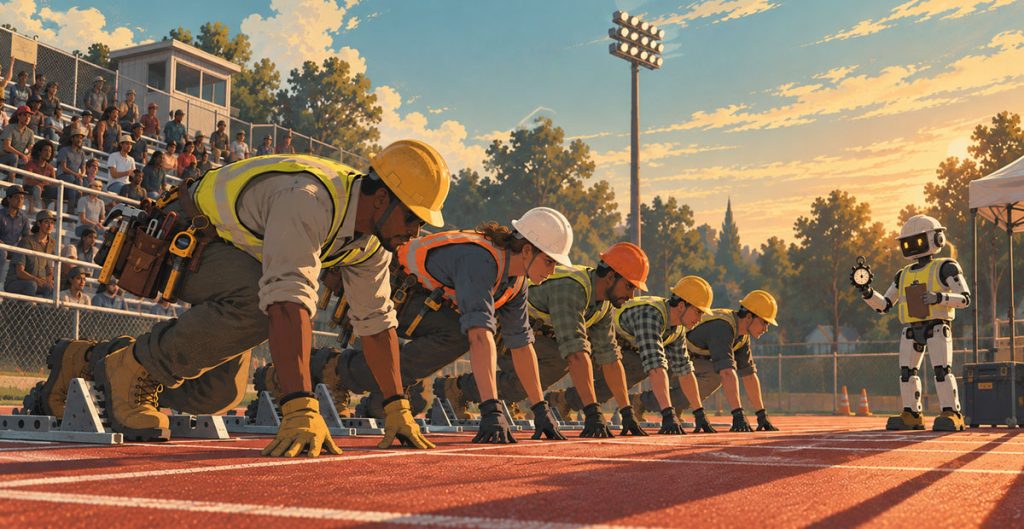
AI is fueling a construction boom that’s putting even more pressure on skilled labor. Now AI is being deployed to make construction more productive.
Apparently, AI has created its own job security.
And there’s real money betting on it. TerraFirma just raised $115M to scale tech that lets smaller crews remotely operate and orchestrate heavy equipment.
Our takeaway is that this goes beyond AI. Productivity is becoming a product benefit. If contractors are looking to technology to save hours, they’ll increasingly expect the products they install to do the same.
When you’re already short on people, the winning brands will turn two-hour jobs into hourlong tasks.

Subscribe to the
DRILL DOWN
This site is protected by reCAPTCHA and the Google Privacy Policy and Terms of Service apply.